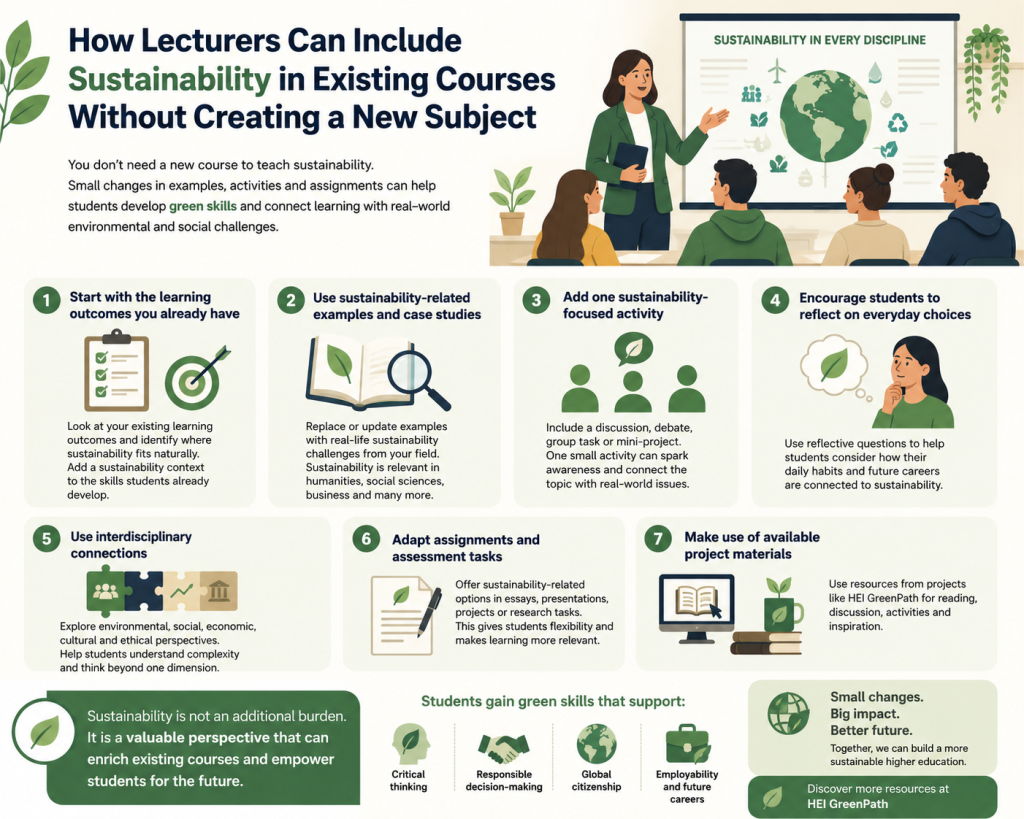
Sustainability is becoming an essential part of higher education. Students increasingly need green skills not only to understand environmental challenges, but also to make responsible decisions in their personal, academic and professional lives. However, many lecturers may feel that sustainability requires a completely new course, additional teaching hours or specialist scientific knowledge.
In practice, sustainability can often be integrated into existing courses through small, meaningful changes. Lecturers do not need to redesign the whole curriculum. They can start by connecting sustainability with the topics, examples, case studies and assignments they already use.
1. Start with the learning outcomes you already have
The first step is to look at the current learning outcomes of the course and ask: where do students already develop skills that are useful for sustainability?
Many courses already include competencies such as critical thinking, problem-solving, communication, ethical reflection, teamwork, research skills or decision-making. These are also important green skills. A lecturer can simply add a sustainability-related context to existing outcomes.
For example, if a course teaches students how to analyse social problems, one assignment could focus on climate communication, sustainable consumption or environmental inequality. If a course develops project management skills, students could design a small sustainability initiative for their campus or local community.
2. Use sustainability-related examples and case studies
One of the easiest ways to include sustainability is to change some of the examples used during classes. Instead of creating a new module, lecturers can introduce case studies that connect the course topic with real environmental or social challenges.
In economics, students can discuss circular economy, green jobs or responsible consumption. In communication studies, they can analyse public campaigns about climate change. In sociology, they can explore environmental justice and the social impact of ecological transformation. In management, they can examine sustainable business strategies. In education, they can discuss how schools and universities can promote sustainable habits.
This approach helps students understand that sustainability is not limited to environmental science. It is relevant to many fields, including humanities, social sciences, business, education and public administration.
3. Add one sustainability-focused activity
Lecturers can begin with one simple activity rather than changing the whole course. A short discussion, group task, debate, reflection exercise or mini-project can help students connect the subject with sustainability.
Examples of classroom activities include:
- a debate on whether universities should reduce single-use materials on campus;
- a group analysis of how a specific profession can support the green transition;
- a short reflection on students’ own consumption, transport or energy habits;
- a case study of a local sustainability problem;
- a comparison of traditional and sustainable solutions in a given sector.
Such activities do not require a separate subject. They can be included as part of regular seminars, workshops or lectures.
4. Encourage students to reflect on everyday choices
Green skills are not only about knowledge. They also involve attitudes, awareness and the ability to reflect on one’s own behaviour. Lecturers can encourage students to think about how sustainability appears in their everyday lives.
This can be done through short reflective questions, such as:
What choices do I make every day that have an environmental impact?
How can my field of study contribute to a more sustainable future?
What kind of green skills might be useful in my future career?
What barriers make sustainable choices difficult for students?
These questions help students see sustainability as something practical and personal, not only theoretical or distant.
5. Use interdisciplinary connections
Sustainability is naturally interdisciplinary. It includes environmental, social, economic, cultural and ethical dimensions. This makes it suitable for many types of courses.
Lecturers can invite students to look at one problem from different perspectives. For example, food waste can be discussed as an environmental issue, an economic problem, a social justice topic, a communication challenge and a question of personal responsibility. Public transport can be analysed through urban planning, health, accessibility, policy, behaviour and technology.
This kind of teaching helps students understand complexity and prepares them to solve real-world problems.
6. Adapt assignments and assessment tasks
Another effective method is to include sustainability in existing assignments. Instead of adding extra work, lecturers can offer students the option to choose a sustainability-related topic within a regular essay, presentation, project or research task.
For example, students could prepare:
- a presentation on green skills in their future profession;
- an essay on ethical aspects of sustainable consumption;
- a campaign plan encouraging students to save energy or water;
- a research project on sustainability practices at their university;
- a case study of a company, institution or community initiative.
This approach gives students flexibility and allows them to connect sustainability with their own interests.
7. Make use of available project materials
Lecturers do not have to start from zero. The HEI GreenPath project provides materials that can support the integration of green skills into higher education. These resources can be used as reading materials, discussion starters, workshop content or inspiration for student assignments.
They can also help lecturers who are not sustainability specialists but want to introduce the topic in a simple and accessible way.
Sustainability as part of regular teaching
Including sustainability in higher education does not always require a new subject. In many cases, it starts with small changes: a new example, a reflective question, a case study, a group task or an assignment topic. These changes can help students understand how their field of study is connected to environmental and social responsibility.
By integrating sustainability into existing courses, lecturers can support students in developing green skills that are useful beyond the classroom. They help students become more aware, responsible and prepared for the challenges of the future.
Sustainability is not an additional burden on teaching. It is a valuable perspective that can enrich existing courses and make learning more relevant to real life.