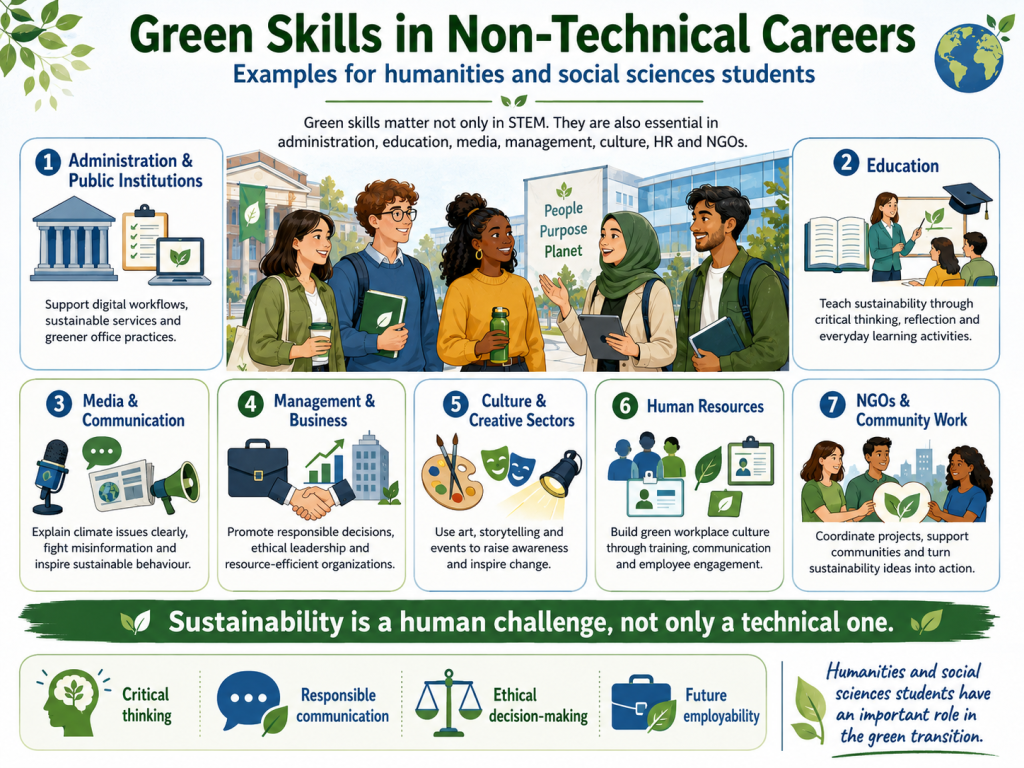
When people think about green skills, they often imagine engineers designing renewable energy systems, scientists researching climate change or technical experts working with new environmental technologies. These professions are important, but they are only one part of the green transition.
Sustainability also needs people who can communicate clearly, educate others, manage organizations, design policies, support communities, create cultural initiatives and make responsible decisions in everyday professional life. This means that green skills are highly relevant not only in STEM fields, but also in humanities, social sciences, business, administration, education, media, culture and non-governmental organizations.
For students of humanities and social sciences, green skills can become an important part of their future employability and civic responsibility.
What are green skills?
Green skills are the knowledge, abilities, values and attitudes that help people support sustainable development. They include understanding environmental and social challenges, thinking critically about the impact of human activity, making responsible decisions and taking action to reduce negative effects on the planet.
Green skills are not only technical. They also include communication, cooperation, ethical reflection, creativity, problem-solving and the ability to understand complex social issues. These are exactly the kinds of skills that humanities and social sciences students often develop during their studies.
Why green skills matter beyond technical professions
The green transition is not only a technological process. It is also social, cultural, educational, economic and political. New technologies will not be enough if people do not understand them, trust them, use them responsibly or support changes in their communities.
For example, climate policies need effective public communication. Sustainable organizations need managers who can introduce responsible practices. Schools need educators who can teach environmental awareness. Local governments need administrators who understand sustainable planning. Media need journalists who can explain complex climate topics in an accessible way.
This is why students from non-technical fields have an important role to play.
Green skills in administration and public institutions
Graduates working in administration, local government or public institutions can use green skills in many practical ways. They may help prepare sustainability strategies, organize greener public services, support environmental campaigns or improve communication with citizens.
In administrative work, green skills can also mean reducing unnecessary printing, using digital documents, supporting sustainable public procurement or organizing low-waste meetings. People working in offices can influence everyday procedures and help institutions become more resource-efficient.
Even small administrative decisions can support broader environmental goals when they are repeated across an organization.
Green skills in education
Education is one of the most important areas for building sustainable societies. Teachers, trainers, academic staff and educational coordinators can help learners understand environmental challenges and develop responsible habits.
Green skills in education may include designing lessons about sustainability, encouraging critical thinking, organizing student projects, supporting outdoor learning or helping young people connect global issues with local action.
Educators do not need to be environmental scientists to teach sustainability. They can include green topics in language classes, social studies, history, ethics, civic education, psychology, pedagogy or cultural studies.
Green skills in media and communication
Media and communication professionals play a key role in shaping public understanding of sustainability. Journalists, content creators, PR specialists, social media managers and communication officers can help explain climate and environmental topics clearly and responsibly.
Green skills in this area include the ability to recognize misinformation, use reliable sources, present complex data in simple language and design campaigns that encourage sustainable behaviour.
For example, a communication graduate may work on a campaign promoting public transport, energy saving, recycling, responsible consumption or climate awareness. Good communication can turn abstract environmental issues into practical messages that people understand and act on.
Green skills in management and business
Managers and team leaders can influence how organizations use resources, treat employees, cooperate with suppliers and communicate their values. Green skills are useful in planning, decision-making, team coordination and organizational change.
In management, sustainability may involve reducing office waste, improving energy efficiency, choosing responsible suppliers, supporting remote or hybrid work where appropriate, measuring environmental impact or introducing ethical workplace practices.
Business and management students can also use green skills to understand consumer behaviour, corporate social responsibility, circular economy and sustainable innovation.
Green skills in culture and creative sectors
Culture has the power to shape attitudes and inspire change. People working in museums, cultural institutions, libraries, festivals, theatres, publishing, design or creative industries can use green skills to promote sustainability through events, exhibitions, storytelling and community activities.
A cultural project can raise awareness about local environmental problems, show alternative ways of living or encourage public discussion about the future. Cultural institutions can also organize greener events, reduce waste, use digital materials and choose sustainable production methods.
Creativity is an important green skill because sustainability often requires new ideas and new ways of seeing the world.
Green skills in human resources
Human resources departments can support sustainability by shaping workplace culture. HR professionals may introduce green onboarding, support employee volunteering, encourage sustainable commuting, organize training or include environmental responsibility in internal communication.
They can also help organizations develop values-based leadership and create conditions where employees feel involved in sustainability goals.
Green skills in HR are closely connected with people, motivation, communication and organizational behaviour. This makes them especially relevant for students of psychology, sociology, management and related fields.
Green skills in non-governmental organizations
NGOs often work directly with communities, education, advocacy, social inclusion and environmental protection. Green skills are useful in project coordination, fundraising, awareness campaigns, workshops, volunteer management and cooperation with public institutions.
Students from humanities and social sciences can contribute by preparing educational materials, organizing events, conducting research, communicating with stakeholders or supporting local initiatives.
In NGOs, green skills are not only about environmental knowledge. They are also about empathy, cooperation, social responsibility and the ability to turn ideas into action.
Examples of green skills for humanities and social sciences students
Students from non-technical fields can develop many green skills during their studies, including:
- critical thinking about environmental and social challenges;
- responsible communication about sustainability;
- ethical decision-making;
- project planning and teamwork;
- understanding social behaviour and public attitudes;
- organizing sustainable events and activities;
- reducing waste and using resources responsibly;
- supporting inclusive and community-based solutions;
- connecting local actions with global challenges.
These skills can be useful in many professions and sectors.
How students can start developing green skills
Students do not need to wait until they enter the labour market. They can begin developing green skills during their studies by choosing sustainability-related topics for essays, presentations or research projects. They can participate in student initiatives, volunteer in local organizations, help organize greener university events or reflect on their own daily habits.
They can also ask how sustainability connects with their field of study. A sociology student can explore environmental inequality. A media student can analyse climate communication. A management student can study sustainable organizations. A pedagogy student can design learning activities about responsible consumption. A cultural studies student can examine how art and storytelling influence ecological awareness.
Green skills as part of future employability
Employers increasingly need people who can understand sustainability and apply it in different professional contexts. Graduates who combine subject knowledge with green skills may be better prepared for changing labour market needs.
For humanities and social sciences students, this is an important opportunity. Their ability to analyse, communicate, educate, organize and understand people is essential for the green transition.
Sustainability is not only a technical challenge. It is a human challenge. That is why green skills belong in every field of study and every career path.