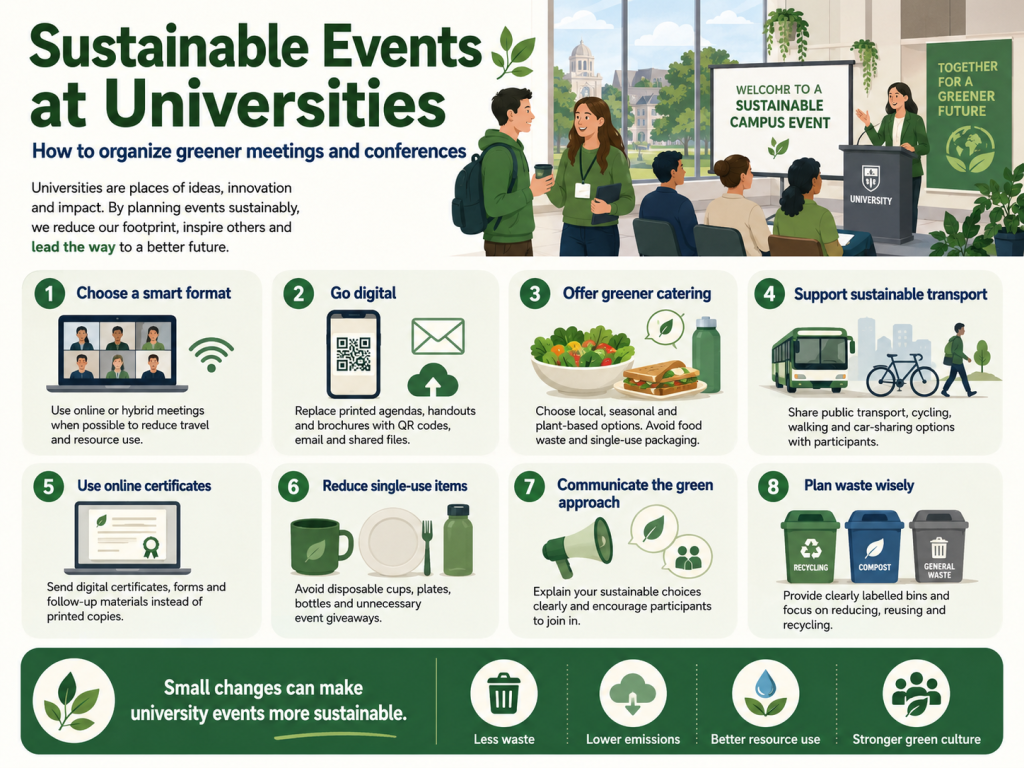
Universities organize many events throughout the academic year: conferences, seminars, workshops, project meetings, open days, training sessions and student activities. These events are important for sharing knowledge and building cooperation, but they can also generate waste, increase energy use and create unnecessary environmental impact.
Organizing a sustainable event does not mean making the event more complicated. It means planning carefully, making responsible choices and encouraging participants to act in a more environmentally friendly way. Even small changes can help universities reduce waste, save resources and promote green skills among students, staff and partners.
1. Choose a sustainable event format
The first step is to decide whether the event needs to take place fully on site. In some cases, an online or hybrid format may be more sustainable, especially when participants would need to travel long distances. Online meetings can reduce emissions connected with transport, accommodation and printed materials.
However, face-to-face meetings are sometimes necessary and valuable. When organizing an in-person event, universities can still make greener choices by selecting an accessible location, reducing printed materials and planning transport responsibly.
A good question to ask at the planning stage is: What format allows us to achieve the event goals with the lowest reasonable environmental impact?
2. Reduce printed materials
One of the easiest ways to make an event greener is to limit printing. Instead of printed programmes, agendas, brochures and handouts, organizers can use digital materials. These may include QR codes, event websites, shared online folders, digital presentations and e-mail communication.
Participants can receive the agenda before the event and access all materials on their phones, tablets or laptops. If printing is necessary, it is better to print only a small number of copies, use recycled paper and avoid unnecessary colour printing.
Digital materials are also easier to update and share after the event. This makes communication more efficient and reduces waste.
3. Offer greener catering
Catering is often one of the most visible parts of an event. It can also create a large amount of waste. Universities can make catering more sustainable by choosing local, seasonal and plant-based options where possible.
Organizers should avoid over-ordering food and ask participants in advance about dietary needs. This helps reduce food waste and ensures that meals are better matched to the group. Leftover food, if safe and allowed by local regulations, can be donated or shared.
It is also important to avoid single-use plastic cups, plates, cutlery and bottles. Reusable dishes, water dispensers, glass bottles and clearly labelled recycling bins are simple but effective solutions.
4. Encourage sustainable transport
Transport can be one of the biggest sources of emissions connected with university events. Organizers can support greener travel by choosing venues that are easy to reach by public transport, bicycle or on foot.
Before the event, participants should receive clear information about sustainable transport options. This can include bus and train connections, bicycle parking, walking routes from nearby stations and car-sharing possibilities.
For international meetings or conferences, organizers can encourage participants to combine several meetings into one trip, choose train travel where realistic, or participate online if long-distance travel is not necessary.
5. Avoid unnecessary promotional items
Many events include promotional materials such as pens, bags, notebooks, folders or small gifts. These items are often used only once or quickly forgotten. A greener approach is to avoid unnecessary giveaways or choose practical, durable and environmentally responsible alternatives.
If promotional items are needed, they should be useful, reusable and produced with sustainability in mind. Digital certificates, online badges or downloadable materials can replace many physical items.
The best promotional message is not always a printed object. It can also be a well-designed digital resource, a useful follow-up e-mail or an inspiring post on the university website.
6. Use online certificates and follow-up materials
Certificates of participation are common at university events, but they do not always need to be printed. Digital certificates are easier to send, store and share. They reduce paper use and make the process faster for both organizers and participants.
After the event, organizers can send participants a short follow-up message with links to presentations, recordings, photos, useful resources and evaluation forms. This supports continued learning and reduces the need for physical documentation.
Online evaluation forms are also a good way to collect feedback while avoiding printed questionnaires.
7. Communicate the green approach clearly
A sustainable event works best when participants understand the reasons behind the choices made by organizers. Clear communication can help people accept and support greener solutions.
For example, organizers can explain that materials are digital to reduce paper use, that reusable cups are provided to avoid plastic waste, or that the venue was chosen because it is accessible by public transport.
This communication should be positive and practical. It should not make participants feel guilty. Instead, it should show that everyone can contribute to a more sustainable academic culture.
8. Plan waste management in advance
Waste reduction should be considered before the event begins. Organizers should think about what types of waste may be produced and how they can be avoided or sorted.
Clearly marked recycling bins should be available in visible places. Participants should know where to dispose of paper, plastic, glass, organic waste and general waste. If catering is provided, food waste should also be managed responsibly.
The best strategy is to prevent waste from being created in the first place. This means avoiding disposable materials, unnecessary packaging and excessive printed content.
9. Involve students and staff
Sustainable events are also an opportunity to develop green skills. Students and staff can be involved in planning, communication, logistics and evaluation. For example, students may help prepare digital materials, design awareness campaigns, monitor waste reduction or collect feedback from participants.
This gives students practical experience and shows how sustainability can be applied in real organizational settings. It also strengthens the connection between learning and everyday university practice.
10. Evaluate and improve future events
After the event, organizers should reflect on what worked well and what could be improved. They can ask simple questions:
Were printed materials really necessary?
Was food waste reduced?
Did participants use public transport?
Were digital tools effective?
What could be done better next time?
Collecting feedback helps universities improve future events and create better sustainability standards over time.
Greener events, stronger university culture
Sustainable events are not only about reducing environmental impact. They are also about showing leadership, responsibility and care for the future. When universities organize greener meetings and conferences, they send an important message: sustainability is part of everyday academic life.
By choosing digital materials, responsible catering, sustainable transport, online certificates, less waste and clear ecological communication, universities can make their events more efficient and more environmentally friendly.
Every meeting, seminar or conference is an opportunity to practise green skills. With thoughtful planning, universities can create events that share knowledge, bring people together and support a more sustainable future.